In-House vs Outsourced SaaS Development - Control & Quality
Software-as-a-Service (SaaS) business process is now the most profitable business model. By doing this, many growing and renowned companies are generating revenue and staying ahead of their competitors. But there is a limitation you may have to handle.
One of the most critical decisions organizations face early in the journey is whether to build their SaaS product in-house or outsource development to an external partner. Choosing the wrong approach can delay launches, inflate budgets, and create technical debt.
Most business owners are confused about choosing in-house SaaS development or Outsourced SaaS development. In that case, you need to learn the difference between In-House vs Outsourced SaaS Development. When you learn everything, it will be easy to choose the best one.
To find a solution to that, we are here to remove all the confusion for business owners.
In this blog, we learn about the key differences between In-House vs Outsourced SaaS Development, including their importance, benefits, costs, and more.
So let's start fresh.
What Is SaaS Development
Before finding the difference in In-House vs Outsourced SaaS Development, it’s important to know what SaaS development involves.
SaaS development involves building cloud-based software that users access via the internet, typically via subscription. Unlike traditional software, SaaS products might require:
- A strong cloud architecture
- Multi-tenant infrastructure
- SDLC model plan
- Continuous deployment and updates
- Strong security and compliance
- Ongoing maintenance and support
Because SaaS products are living systems that evolve continuously, the development approach you choose must support long-term agility and reliability.
What Is In-House SaaS Software Development
So, before the full comparison of in-house vs outsource SaaS development, let's briefly discuss in-house SaaS software development first. In-house software development involves all the processes of designing, building, deploying, and maintaining a Software-as-a-Service product using an organization’s internal workforce. Not taking any particular help from third-party vendors or external agencies. All the work, including testing, model selection, and coding, is handled by the in-house development team. Key Characteristics of In-House SaaS Development:-
- Full internal control
- Dedicated internal team
- Long-term product ownership
- Stronger intellectual property protection
- Cultural alignment
These are the common characteristics of any in-house SaaS development team in a software company. Rather than that, a typical in-house SaaS team has some responsibilities that include:
|
Team Structure |
Responsibilities |
|
Frontend Developers |
|
|
Backend Developers |
|
|
DevOps Engineers |
|
|
QA/Test Engineers |
|
|
UI/UX Designers |
|
|
Product Manager |
|
|
Security Specialists |
|
Now the question may arise in the head, which companies can get benefits from in-house SaaS development projects? It might be
- Large enterprises
- Highly sensitive products
- Long-term core platforms
What Is Outsourced SaaS Development
This is the total opposite of in-house software development. It means you can get your desired SaaS application development through a different company or internationally. Formally, you assign an external software vendor, agency, or remote development firm u that sets out to design, build, test, deploy, and sometimes maintain your Software-as-a-Service product.
In this model, the outsourcing partner provides the technical workforce, development infrastructure, and often the project management framework. The client company typically retains ownership of the product vision, business requirements, and final deliverables while the vendor handles most of the technical execution. Some characteristics of the outsourced development team:-
- External expertise
- Flexible Engagement Models
- Vendor-managed delivery
- Faster Resource Availability
|
Common Outsourcing Models |
Responsibilities |
|
Project-Based Outsourcing |
|
|
Dedicated Development Team |
|
|
Staff Augmentation |
|
It's basically another way to customize any kind of software development project. This outsourced SaaS development is best for
- Startups and MVPs
- Budget-constrained companies
- Rapid product launches
So, after learning the basic definitions and responsibilities of in-house and outsourced SaaS development, let's learn in detail the difference between them.
In-House Vs Outsourced SaaS Development - Top Differences
Choosing between them is really tough. Both processes deliver the output. But the time, cost, speed, and scalability might differ.
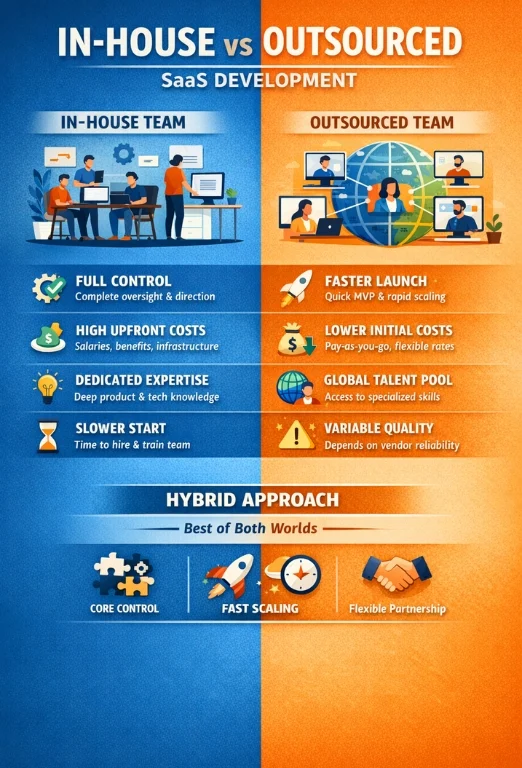
In-House vs Outsourced SaaS Development — Detailed Comparison Table
|
Critiria |
In-House SaaS Development |
Outsourced SaaS Development |
|
Initial Setup Time |
Slow hiring, onboarding, and environment setup may take 2–6 months |
Fast — vendor teams can often start within days or weeks |
|
Upfront Investment |
High salaries, recruitment, and infrastructure |
Low to moderate |
|
Ongoing Cost Model |
Fixed and predictable but heavy |
Variable and flexible |
|
Control Over Roadmap |
Full control |
Shared control |
|
Technical Decision |
Fully internal |
Often influenced by vendor expertise |
|
Speed to Market |
Slower at the beginning |
Significantly faster |
|
Access to Talent |
Limited to local or regional hiring pool |
Global talent pool available |
|
Scalability of Team Size |
Slow — requires new hiring cycles |
Fast — vendors can scale quickly |
|
Flexibility |
Low — fixed |
High |
|
Quality Consistency |
High |
Varies |
|
Communication Flow |
Strong alignment with company mission |
May vary across vendors and regions |
|
Security & IP Protection |
Highest level of inherent protection |
Requires legal and technical safeguards |
|
Maintenance & Support |
Fully internal responsibility |
Often included in a vendor contract |
|
Management Skill |
Requires strong engineering leadership |
Requires strong vendor management |
|
Time Zone Impact |
Minimal |
Can be a challenge or an advantage |
|
Best for MVP Development |
Usually not cost-efficient |
Highly suitable |
These are all the things in short format. Below, we discuss it in a deeper strategic breakdown and the most important comparison factors. This will help founders, CTOs, and product leaders understand not just what is different—but why it matters in real business situations.
In-House vs Outsourced SaaS Development - Cost Comparison
For any SaaS or software development project, cost is the main concern. So before picking in-house or outsourcing SaaS development, you need to clear it out. We will give two scenarios for you.
One is the long-term project time margin, and the other is the short-term project time. In-house SaaS development needs substantial upfront investment. Companies must recruit skilled engineers, designers, QA specialists, and DevOps professionals—often in a highly competitive talent market. On the other side, you need to give benefits, bonuses, recruitment fees, onboarding time, hardware, software licenses, office space (if applicable), and ongoing training.
As a result, the team is fully stable and productive, and the cost of development work drops. If your project is kinda big and the time duration is not that important, then in-house will be the best choice. Mature SaaS companies often reach a point where internal development delivers better long-term ROI.
On the other hand, if time is very important and you want to get your project done with a tight deadline, then outsourcing SaaS development is the choice. In this SaaS development time, instead of committing to full-time payroll, companies pay for specific deliverables, hours, or dedicated team capacity. This model protects early-stage cash flow and reduces financial exposure during uncertain product phases.
Outsourced vs in house development: Decision
|
Conditions |
Quick decision |
|
Short term |
Outsourcing is cheaper |
|
Long term |
In-house may be more economical |
Time to Market
Another important thing to remember is the time. Time maintenance is quite important for any development project. If time is critical to the development project, outsourcing SaaS development is an option. Why outsource SaaS development? Why pick SaaS development over in-house development?
Because recruitment and infrastructure setup are already complete, development can begin almost immediately after requirements are finalised. This dramatically reduces the “time-to-first-code” interval. Rapid MVP delivery is one of the strongest arguments for outsourcing.
On the other hand, the in-house process is lengthy. It takes time to hire experienced software engineers. Even after hiring, new team members require onboarding, environment setup, and alignment with product goals.
in-house vs outsourcing software development: Decision
|
Conditions |
Quick decision |
|
Need fast launch |
Outsource SaaS Development |
|
Playing long game |
In-house can catch up |
Project Control
Control is the main priority; in-house SaaS development is up in the table. With the internal team, you can easily maintain full authority over architecture decisions, coding standards, release timing, and product priorities. If leadership decides to change anything, it's too easy to do so quickly. Because the in-house team is easily accessible and always available. But on the other hand, immediate change is not possible for the outsourced SaaS development team. This level of control becomes especially important when:
- The SaaS product is the company’s core intellectual property.
- Rapid strategic pivots are expected.
- Deep technical customization is required.
- Regulatory oversight is strict.
In-house vs Outsource:- Decision
|
Conditions |
Quick decision |
|
Mission-critical platform |
In-house |
|
Clearly defined build |
Outsourcing works well |
Talent Access
In SaaS development, talent hunting is quite time-consuming and expensive. To solve this problem, you need to choose the best possible option quickly.
If you are already working on an in-house software development team, then it's quite a lengthy process, actually. Highly specialized roles—such as cloud security experts, AI engineers, or large-scale distributed systems architects—can be difficult and expensive to recruit locally. But in the meantime, outsourcing opens access to a global talent marketplace. Reputable vendors maintain specialists across multiple technologies and industries.
So it helps to find the exact expert quickly. But what exactly does the in-house team do then? They can build their own and develop a deeper product context over time.
As a result, Outsourced specialists may have broader technical exposure but less embedded product knowledge.
Inhouse development vs outsourcing: Decision
|
Conditions |
Quick decision |
|
Building core team culture |
In-house |
|
Need rare skills |
Outsourcing works well |
Communication Barrier
Communication either speeds up development or slows down the workflow. In that sense, an in-house SaaS development team can benefit. Questions get answered quickly, cross-functional collaboration is smoother, and product context is easier to maintain. It reduces friction in fast-moving environments. It also improves the overall workflow of the development stage. You can also maintain the communication barrier with strong discipline in outsourced development. Outsourced teams require more structured communication discipline. Successful outsourcing relationships rely heavily on:
- Well-defined sprint rituals
- Clear documentation
- Regular standups and demos
- Shared project management tools
- Strong product ownership on the client side
In-House vs Outsourced SaaS Development:- Decision
|
Conditions |
Quick decision |
|
Simplicity |
In-house |
|
Requires process discipline |
SaaS development outsourcing |
Risk Level
Any SaaS development method is not risk-free. In-house or outsourcing has its risks, and one needs to accept them and overcome them through strategy.
In-house outsource development projects risk centre primarily around people and financial exposure. Companies may face some limitations like:-
- Hiring delays
- Unexpected employee turnover
- Skill gaps
- High fixed payroll burn during slow periods.
Building and retaining a high-performing engineering team requires strong leadership and culture.
Outsourcing risks mainly depend on the vendor dependency and execution quality. Potential issues include inconsistent code quality, communication gaps, hidden costs from scope changes, and long-term lock-in if knowledge transfer is weak.
So what is the solution for that? The solution is quite simple and effective.
Companies with strong technical leadership and HR capabilities often manage in-house risk effectively. Companies with strong vendor governance and product management discipline can outsource successfully.
In-house vs Outsource:- Decision
|
Conditions |
Quick decision |
|
Strong HR + engineering leadership |
In-house |
|
Strong vendor governance |
Outsource |
Long-Term Maintenance
A SaaS program is live, so it requires regular updates and maintenance. Without regular maintenance and updates, any software or project cannot perform well in the market. So which ones perform better in these sections? In-house vs outsource SaaS development, these are the crucial sections that need to be focused on.
There is no doubt that the in-house team has better maintenance knowledge. They have deep institutional knowledge about the system architecture, technical debt areas, customer behaviour, and historical design decisions.
With the proper knowledge, it helps to ensure continuity, making long-term maintenance smoother and often more efficient. They can easily identify diagnostic issues and resolve them.
In outsourcing, maintenance quality depends heavily on the engagement structure. Critical success factors include:
- Clear support contracts
- Comprehensive documentation
- Proper knowledge transfer
- Stable vendor relationship
- Source code ownership
If the maintenance program isn't engaging, it will be a downside for the outsourced SaaS development project. In the long run, it can create a dependency in which the vendor becomes the only party capable of maintaining the system.
But proper communication and well-managed relationships can provide long-term, effective support through an outsourced development team.
In-House vs Outsourced SaaS Development: Decision
|
Conditions |
Quick decision |
|
Long lifecycle core product |
In-house SaaS development |
|
Defined support contract |
Outsourcing saas development |
These are the main things to remember before choosing any of them. We covered the top criteria, and now it's your turn to choose. But still, if you are confused about choosing one of them, then you may follow our next section to get a more summarised answer.
What To Choose - In-House Vs Outsourced Saas Development
If you are still not clear about what to choose in in-House vs outsourced SaaS development, then this section is the key for you. In all details, we summarise here. First things first, it is contextual and often evolves over time. It normally depends on what you want. If you are really in a hurry to build your development project in a short time period, then go for an outsourced SaaS development project. But remember, the most successful SaaS companies think in phases, not absolutes.
In-House vs Outsourced SaaS Development - Final call
|
If |
Choose |
|
Need fast launch |
Outsource |
|
Limited internal expertise |
Outsource |
|
Tight upfront budget |
Outsource |
|
Need full product control |
In-House |
|
Building a long-term SaaS asset |
In-House |
|
Strong internal tech leadership |
In-House |
|
Need speed and ownership |
Hybrid model |
|
Scaling unpredictably |
Hybrid model |
|
Want core control but flexible execution |
Hybrid model |
The debate between in-house vs Outsource SaaS development is not about who is winning; it's all about which model is universally better. In-house SaaS development holds the power for maximum control, stronger IP protection, and deeper long-term innovation capability. On the other side, outsourcing development defines speed, flexibility, and cost efficiency. Sometimes you need both sides, so go for the hybrid model that offers the most practical balance. Before implementing the project, fix the budget, timeline, and features, then choose the model that best meets your needs.
Remember:-
The right choice is the one that supports both your immediate launch goals and your future growth strategy.
Which Is Cheaper: In-House vs Outsourced SaaS Development?
In the short term, outsourcing is usually cheaper because you avoid hiring and infrastructure costs. Over the long term, in-house teams can become more cost-effective
Is Outsourcing Saas Development Risky?
Outsourcing carries different risks rather than higher risks. Common concerns include:-
- Vendor dependency
- Communication gaps
- Quality inconsistency
When Should a Startup Choose Outsourcing?
Startups typically benefit from outsourcing when they need to launch an MVP quickly, have limited technical expertise, or must conserve cash.
When Is In-House Development The Better Choice?
In-house development is ideal when the SaaS product is mission-critical, requires continuous innovation, or involves sensitive data and strict compliance.
Can Companies Switch from Outsourcing to In-House Later?
Yes, and many successful SaaS companies do exactly this. A common path is to outsource early development for speed, then gradually build an internal team once the product gains traction and long-term needs become clearer.
What Is a Hybrid SaaS Development Model?
A hybrid model combines both approaches. Typically, companies keep core architecture, product strategy, and security in-house while outsourcing specific features, scaling work, or short-term projects.
Does Outsourcing Mean Losing Control of The Product?
Not necessarily. With proper documentation, sprint planning, and technical governance, companies can maintain strong strategic control.
How Long Does It Take to Build an In-House SaaS Team?
Building a solid internal team often takes 3–9 months, depending on hiring market conditions and role complexity. This includes recruiting, onboarding, and reaching full productivity.
What Is the Biggest Mistake Companies Make When Choosing?
The most common mistake is deciding based only on short-term cost. The smarter approach is to evaluate product importance, speed requirements, long-term roadmap, and internal capabilities before choosing a model.

Contents
- What Is SaaS Development
- What Is In-House SaaS Software Development
- What Is Outsourced SaaS Development
- In-House Vs Outsourced SaaS Development - Top Differences
- In-House vs Outsourced SaaS Development - Cost Comparison
- Time to Market
- Project Control
- Talent Access
- Communication Barrier
- Risk Level
- Long-Term Maintenance
- What To Choose - In-House Vs Outsourced Saas Development
- Endnote
- FAQs



Pay With


