Time Tracking Software For Remote Employees
Time directly impacts profitability, productivity, and growth for any kind of business. So managing time properly can help to build a solid structure for your business. Not only in a business, but it's also disciplined in-house employees and maintains an eco-friendly environment. But suppose if your company have remote employees, then what should we do? In this digital, advanced-automation era, it's not an issue.
Time tracking software for remote employees is the solution for that. Time-tracking software gives you visibility and control for every employee, not just remote employees. It will monitor their daily work process time-to-time, their ongoing projects, deadlines, attendance, punch time, payroll & more.
Nowadays, many local and international companies go for remote employees for their international projects. In that case, time-tracking software for remote employees is the clear choice. It provides a 360-degree overview for every employee, reducing stress for the HR manager and overall improving productivity for the company.
In this blog, we aim to clarify all important aspects of time tracking software and why it is essential for remote employees.
So let's start.
What is Time Tracking Software
Time tracking software is a tool that helps analyze time more effectively. On the other hand, it's the solution for recording how much time employees spend working on tasks, projects, or shifts—regardless of their physical location. You can track both on-house employees and remote employees. Real-time insights and day-to-day summaries for every employee help track, evaluate, and manage easily.
These tools allow employees to:
- Clock in and out digitally
- Track hours spent on tasks or projects
- Submit timesheets automatically
And allow employers to:
- Monitor work hours in real time.
- Ensure accurate payroll
- Analyze productivity trends
- Maintain labour law compliance.
Time Tracking Software vs Employee Monitoring Tools
Most people are getting confused about time tracking software vs employee monitoring tools. But unfortunately, they are not the same. Their purpose is completely different. But one thing is common to both time-tracking software and employee monitoring tools, which are both used for employee purposes.
Time Tracking Software
Time-tracking software is primarily used for time-tracking within an individual project. It's basically designed to track all the hours employees spend working on tasks, projects, or shifts. The software's primary goal is to ensure accuracy and accountability.
Key focus of this time tracking software :
- Accurate payroll and invoicing
- Project cost control
- Productivity analysis at a high level
- Labor law compliance
Employee Monitoring Tools
Employee monitoring tools are used to monitor and observe employee behaviour during work hours. The main difference between these two is that the remote worker monitoring software focuses on behavioural oversight rather than time checking.
Key responsibilities of employee monitoring software:
- Screenshots or screen recordings
- Keystroke tracking
- Website and application usage
- Webcam or location monitoring (in some cases)
Time Tracking Software vs Employee Monitoring Tools: Core difference
|
Feature |
Time tracking software |
Employee monitoring tools |
|
Track work hour |
✅✅ |
✅✅ |
|
Focus on productivity |
✅✅ |
❌❌ |
|
Privacy |
✅✅ |
❌❌ |
|
Payroll integration |
✅✅ |
⚠️ |
|
Employee trust |
High |
Low |
How Time Tracking Software Works
The time-tracking software mainly records work hours regardless of location, time zone, or work schedule. It maintains the visibility and true monitoring for the remote employees. The total process begins when a remote employee logs in through web-based platforms. A web-based platform, like a desktop app, or a mobile application.
After logging into the system, the tools automatically track the time of login to the project. Some tools automatically capture actual working time, reducing the risk of forgotten or incorrect entries.
Some tools automatically track time in the background. That helps remote employees dont put in manual input and focus on their work easily. Employees start work, and the software automatically tracks time to the specific project, stores it, and syncs with the central software hub. So, company management or HR can easily track time and activity.
Not only can the manager easily track and summarise work on a monthly, weekly and daily basis. With this data, they can check individual employees' performance and their work progress. The system can also convert the hours into a spreadsheet and share it with the manager.
All that data at the end of the year or month helps integrate with the payroll service and also evaluate the employee's overall performance and KPIs. As a result, it helps reduce the hr task and allows them to focus on other important things.
Core Features of Time Tracking Software
Without a doubt, the right time-tracking software can bring a lot of order to work and improve workflow. But there are many software solutions available on the market. Still, you need to choose one over the others. So it's kinda tough. Before choosing any time management software, check that the features you need are available. Bdtask, a leading software company, always prioritizes customer satisfaction and top-notch software solutions. Their HR manager software provides comprehensive time tracking, HR management, accounts, and more at a reasonable price. So why not give it a try, and let's check which features are needed in the best time tracking programs?
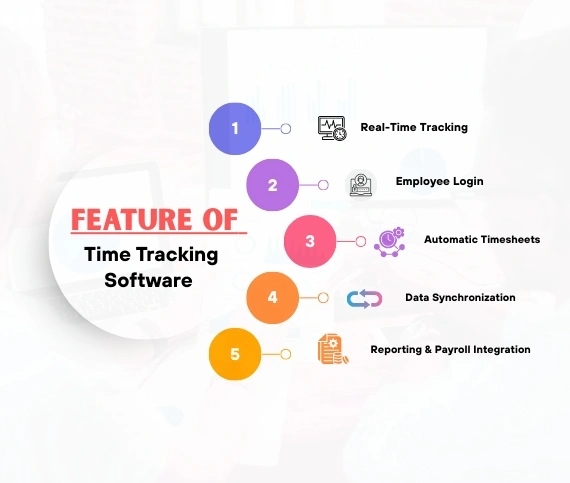
Real-Time Tracking
Time tracking is a key indicator and foundation for effective remote work. It will help maintain the in-and-out times of any employee and provide complete coverage of the end time of the working project. It's also pretty helpful for hr manager and management.
They can track down a remote employee to see what they're working on, how it's progressing, and whether they are working. Not only that, it will give updated employees on how long they have been active, without interrupting them. This feature is a game-changer for any time tracking software for remote employees, without a doubt.
Employee Login
Employee login features are essential for any remote-based company. Because when an employee logs in to their project, their working time is automatically counted down. It will include start/stop work, logging in/out times, monitoring activity and automating time sheets. This feature will help save significant time for both employees and management.
Automatic Timesheets
Manual time tracking, in one word, is “pain”. Dont take it otherwise. But in this digital age, managing paperwork manually is really stressful and time-consuming. The software automatically converts tracked hours into digital timesheets. Without any complaint, it reduces many things, including:
- Human error
- Time theft or inflated hours
- Administrative workload for HR and finance teams
For remote employees, automatic timesheets mean less paperwork and fewer mistakes that could delay payment. For employers, they ensure consistent, audit-ready records that can be reviewed and approved with just a few clicks.
Data Synchronization
Another important feature of time-attendance software is data synchronization. With this tracking software, you can easily collect all the data and store it in one central hub. It will help to collect any data from any time, and there is no need to wait for a manual spreadsheet. Another important thing to remember is that employee data is more secure than ever.
Reporting & Payroll Integration
Reporting and payroll integration are other essential features of time tracking software for remote employees. You can easily report, and the report is integrated with the payroll system, providing an instant update. No hassles with manual errors and improved workflow for management and employees. This integration:
- Eliminates duplicate data entry
- Reduces payroll errors
- Ensures employees are paid accurately and on time
- Simplifies billing for hourly or contract work
For remote teams, automated payroll integration builds trust by ensuring consistent, timely compensation, regardless of location.
Mobile & Desktop Apps
Another primary feature of time tracking software is mobile apps. Remote employees work from various locations, including home offices, coworking spaces, and client locations. So, it's impossible to carry your personal desktop all the time. For that reason, a mobile app for this tracking software can perform many tasks. You can easily access it from anywhere.
Mobile apps allow employees to:
- Track time on the go
- Clock in from different locations
- Log hours even while travelling
Screenshot & App Tracking
These tools help to periodically capture screenshots or track which applications and websites are used during work hours. Tolls takes random screenshots multiple times during work hours. That helps provide deeper visibility and ensure employees work properly.
Some industries benefit greatly from outsourcing, freelancing, or high-security environments. Sometimes, remote employees do not take it easily, but management can share these things politely.
Best practices include:
• Informing employees clearly about what is tracked
• Limiting screenshots to work-related apps
• Allowing privacy controls or blur options
These are the primary, and quite mandatory, features of any remote time-tracking software. Easily customizable according to the requirements. When it comes to customization, Bdtask, a leading software development company, offers customized software development at a reasonable cost.
Benefits of Time Tracking Software for Remote Employees
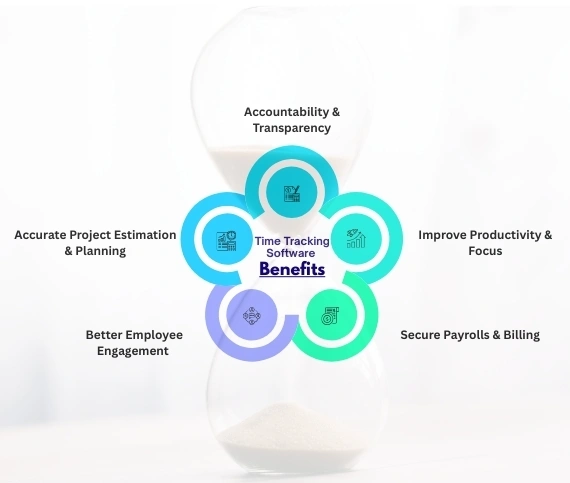
A time-tracking system not only tracks employee time but also brings many benefits for the team and for management & organization. It helps to maintain a solid structure within the company and among the employees. Let's check some of the benefits that are driving many companies to use it for future growth and ROI.
Ensure Accountability & Transparency
In a remote job, a company faces one problem: keeping its remote employees productive. Time tracking software ensures an accurate log of what employees are working on and when. It gathers logs showing start/end times, breaks, task durations, and project allocation. As a result, it will minimize confusion over hours worked or task completion and improve team confidence.
Improve Productivity & Focus
Sometimes, many remote employees take it negatively when they're tracked by the time they spend per day. But if you think it more carefully, it will actually help them. Because it helps to memorize and improve the usability of their time.
As a result, employees can identify peak productivity hours and structure their day around those times. They can also divide high-impact work and low-impact work, and they use these tools to structure their day around those times.
They also use and adjust priorities, work and invest more energy in high-impact work. The moral of the topics is to increase focus on work. So when you focus more on the high-impact work, you get more productive work.
More productive work leads to greater brand value and a stronger company reputation.
Accurate Project Estimation & Planning
Using time management software makes project estimation & planning easier than ever. With this software, you can easily monitor and calculate the length and duration of each work task. With this accurate time and duration, you can easily set a time limit and plan for upcoming remote jobs. Visibility into time management helps ensure no single team member is overloaded while others are underutilized.
Secure Payrolls & Billing
Another benefit of time tracking software for remote employees is secure payroll and billing management. Time-tracking software provides accurate billing information, which increases trust. Employees are paid for actual hours worked rather than estimates or memories. It reduces human errors and manual workflow.
Better Employee Engagement
Time tracking software, or time monitoring software, manages all time-related tasks quite easily. Tasks include transparency, flexibility, and integrations, with a focus on project/task tracking, clear progress reporting, and automated logging. When this task is properly maintained, all employees can see their own productivity patterns and take ownership of their schedules. As a result, it will improve the team's and individual employees' workflows.
At the end of the day, effective time tracking supports personal growth and performance improvement.
Above are all those benefits, more or less, a time tracking software for remote employees helps to organize the work and store all the data accurately. That helps to deliver the project on time and also helps to maintain an eco-friendly bonding with management and remote employees.
How to Choose the Best Time Tracking Software
So after all the discussion about this, what do you think? Is it really necessary for your company or organization? The answer is definitely yes. But still, you need to think before choosing best time tracking software for remote employees. Because there is a lot of software available, and it offers many features. Which one is trustworthy, bug-free, and user-friendly? Before investing your valuable money in this kind of tool, you need to check a few things first. Includes :
Time tracking software for remote employees: Initial criteria
|
Condition |
Check list |
|
Team Size & Scalability |
Ensure the software grows with your business. |
|
Pricing Structure |
Understand per-user pricing, free plans, and hidden fees. |
|
Integrations |
Look for compatibility with your payroll, accounting, and project management tools. |
|
Usability |
A simple interface increases employee adoption. |
|
Data Security & Privacy |
Check for SOC 2 compliance, encryption, and secure data storage. |
|
Customer Support |
U.S.-based or USA-timezone support is a major advantage. |
These are the things that need to be checked before proceed on any software. Apart from that, if you want a complete package, then the HR manager from bdtask is a complete software that has all the hr related and time tracking features at a low cost.
Final Note
Remote work depends on clarity, communication, and smart management. For that, time-tracking software for remote employees is the best choice, for sure. Proper maintenance, proper management, and smart tools can ensure maximum employee output and sustainable growth.
FAQs
Why Do Remote Teams Need Time Tracking Software?
Remote teams need time tracking to ensure accountability, measure productivity, manage workloads, and maintain proper transparency.
Does Time Tracking Software Increase Remote Employee Productivity?
Yes. Time tracking improves productivity by helping employees stay focused and reduce distractions.
Is Time Tracking Software Legal for Remote Employees?
Yes, time tracking software is legal when employees are informed, and data collection follows local labour and data protection laws.
Does Time Tracking Software Monitor Employees All The Time?
No. Modern time tracking software focuses on work hours and task duration, not constant surveillance, ensuring employee privacy.
Is Time Tracking Useful for Small Remote Teams?
Yes. Small remote teams benefit from improved visibility, better task management, and reduced administrative work using time tracking tools.
Does Time Tracking Software Work on Mobile Devices?
Yes. Most time tracking tools support web, desktop, and mobile apps for remote employees.
Is Employee Data Secure in Time Tracking Software?
Yes. Reliable time tracking software uses encryption, secure servers, and access control to protect employee data.
Can Time Tracking Software Integrate with Other Tools?
Yes. It integrates with payroll, HR, accounting, and project management tools for seamless workflow management.
Who Should Use Time Tracking Software?
Remote teams, freelancers, SaaS companies, IT firms, agencies, consultants, and hybrid workplaces benefit most from time tracking software.

Contents
- What is Time Tracking Software
- Time Tracking Software vs Employee Monitoring Tools
- How Time Tracking Software Works
- Core Features of Time Tracking Software
- Benefits of Time Tracking Software for Remote Employees
- Ensure Accountability & Transparency
- Improve Productivity & Focus
- Accurate Project Estimation & Planning
- Secure Payrolls & Billing
- Better Employee Engagement
- How to Choose the Best Time Tracking Software
- Final Note



Pay With


