Difference Between Hardware and Software
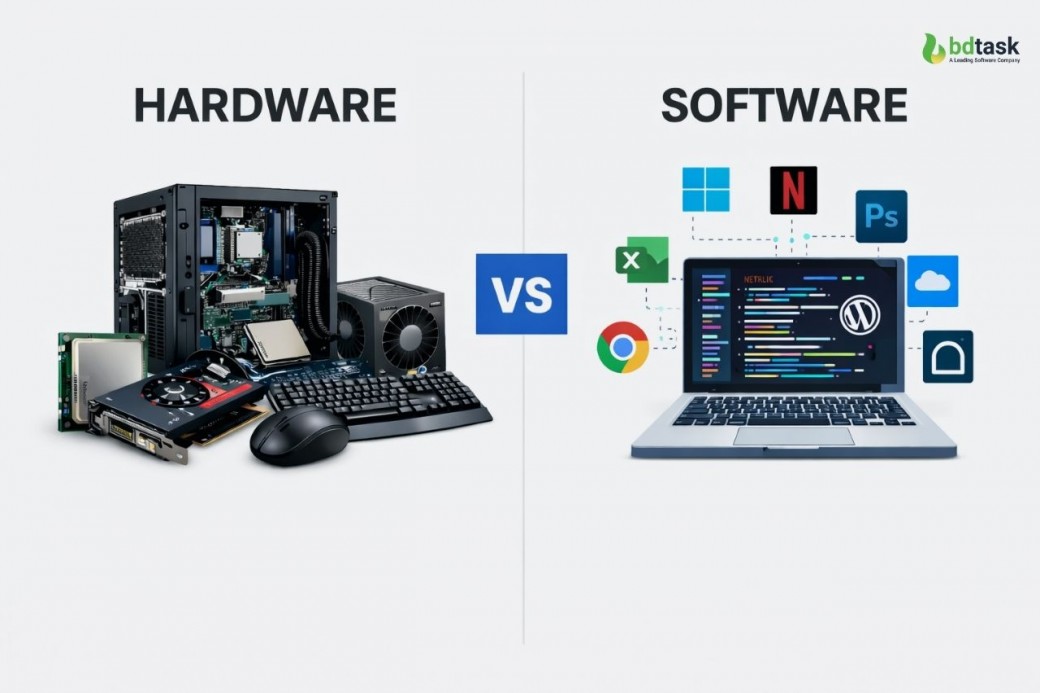
Basically, hardware and software are the two main parts of a computer system. The primary difference between hardware and software is that hardware refers to the physical components of a system. In contrast, software is a set of instructions that exists only in a digital form. These two are integral to running a system. Mobile phones, laptops, and PCs are part of our daily lives. Understanding the real difference between these two helps identify the fundamental concepts of computer science and information technology.
In the following blog, we break down every single detail about hardware, software, differences, and how they work together as a team.
Let's start.
What is Hardware and Software?
Hardware is the physical part of a computer. On the other hand, Software is the Instructions that control the software. Hardware is responsible for the input, processing, storage, and output of data. Software controls hardware operations and enables users to interact with the device. But still, they have some differences between hardware and software. Let's check it one by one.
What Is Hardware?
Hardware is a physical, tangible component. You can see, touch, and physically handle it. It can be used on any computer system or electronic device. All these components work together to receive input, process data, store information, and produce output. One important fact is that hardware supports the mechanical and electronic parts. Without it, a computer or digital device is not operational.
Key Characteristics of Hardware:-
- Physical and tangible
- Seen and touched
- Manufactured in factories
- Subject to wear and tear
- Cannot work independently without software
What Is Software - Quick Overview
Software is a set of instructions that utilizes a computer system to execute specific tasks. You can mainly call it programs, instructions, and related data. You can not touch or see it. But you can see it through displays, text, music, calculations, or running applications. Software is also easily modified and upgraded to adapt to different PC configurations.
Key Characteristics of Software:-
- Non-physical and intangible
- It exists in digital form.
- Developed using programming languages
- Software is written, tested, and maintained by programmers and developers.
- Does not wear out physically
- Needs hardware to run
- dependent and requires hardware to execute
- easily copied or updated
- Software can be installed, duplicated, upgraded, or removed easily.
What Is the Difference Between Hardware and Software
In this segment, you can see the difference between software and hardware. We research it from many different angles and gather all the important information about it.
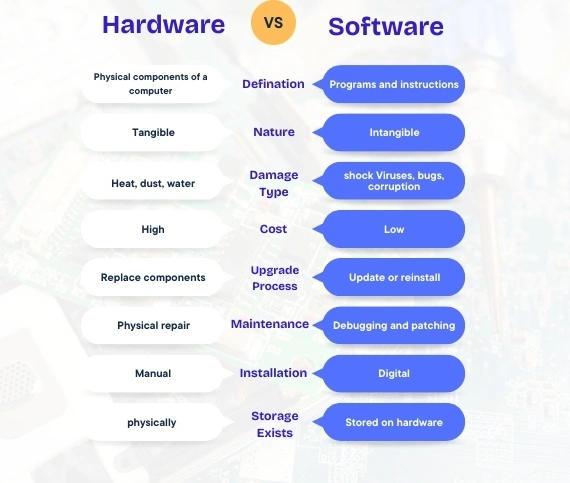
Hardware vs Software:- key difference
|
Comparison Topic |
Hardware |
Software |
|
Define hardware and software |
Physical components of a computer |
Programs and instructions |
|
Nature |
Tangible |
|
|
Physical Form |
Has physical shape |
No physical form |
|
Visibility |
Can be seen |
Cannot be seen physically |
|
Touch |
Can be touched |
Cannot be touched |
|
Creation Method |
Manufactured in factories |
Developed by programmers |
|
Dependency |
Needs software to work |
Needs hardware to run |
|
Wear and Tear |
Suffers physical wear |
No physical wear |
|
Damage Type |
Heat, dust, water |
shock Viruses, bugs, corruption |
|
Upgrade Cost |
High |
Low |
|
Upgrade Process |
Replace components |
Update or reinstall |
|
Maintenance |
Physical repair |
Debugging and patching |
|
Storage Exists |
physically |
Stored on hardware |
|
Transferability |
Cannot be copied |
Easily copied |
|
Flexibility |
Limited |
Highly flexible |
|
Security |
Threat Theft |
Hacking |
|
Installation |
Manual |
Digital |
|
Lifespan |
Limited |
Unlimited (logical) |
|
performance |
Regular upgrade |
Improves and optimizations |
|
Initial cost |
Usually high |
Low and moderate |
|
Examples |
|
|
Different Types of Hardware - Details Breakdown
Hardware can be divided into five groups. All are parts of hardware. Includes :
- Input Hardware
- Output Hardware
- Processing Hardware
- Storage Hardware
- Networking Hardware
Let's review and see an example of each section that will be helpful.
Input Hardware
As the name suggests, the input device is specialized for taking input from the users. It takes data from users and sends it to the system. Basically, they are the components that the end-users directly interact with. Its basically a link-up between the user and the computer. Without it computer would not be able to interact with or do any work. The keyboard is the main and most commonly used input device. It helps to users to type text, numbers, and commands. Input devices help the computer understand user requirements and provide accurate output based on the given instructions.

These are the most common examples of input devices. Example :
- Keyboard
- Mouse
- Touchscreen
- Scanner
- Microphone
Output Hardware
Like input devices, output devices are peripheral devices that display the results of user input. It's basically the display or presentation of the processed information to the user. When the input data is functional, the output data presents the results in a readable, understandable form. A monitor displays text, images, and videos.
On the other hand, the printer helps to print the hard copies of documents, images, or reports on paper. The speaker is the source of audio input, providing voice, music, and audio functionality. On the other hand, a projector is another example of an output device that projects the screen onto a large screen. Output devices help users receive information clearly and understand the results of computer processing.
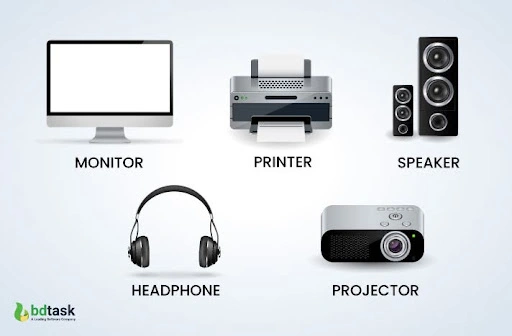
Example of an output device
- Monitor
- Printer
- Speakers
- Headphones
- Projector
Processing Devices
Internal components are usually hidden in the system unit, but the user can see or upgrade them if necessary. Its primary responsibility is to perform calculations, perform logical operations, and process data. This device works as the brain of the system. The CPU (Central Processing Unit ) is the primary processing device.
This device executes instructions, processes data, and manages communication between hardware components. All of the devices work together to run smoothly. Another processing device is a GPU. A GPU helps manage all graphics and visual data. It's necessary for gaming and other graphics-related work to be as smooth as possible.
This unit's ultimate goal is to ensure work is completed efficiently and accurately.
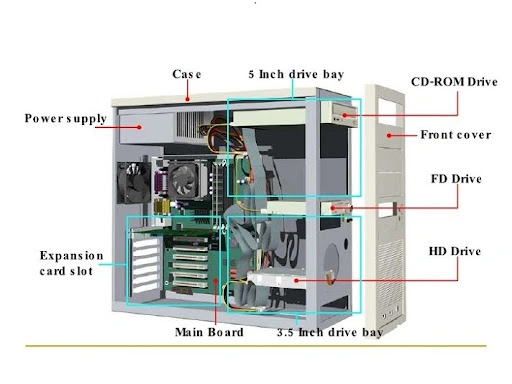
Example:-
- CPU (Central Processing Unit)
- GPU (Graphics Processing Unit)
Secondary Storage Devices
Secondary storage devices are usually external devices that store both permanent and temporary data. It basically helps the user to save files, software, and system data for future use. On the other hand, HDDs are well-suited for large files and data, but they have limitations. Although it maintains a slower cost, it operates at a slower speed. A Solid State Drive (SSD) is faster than an HDD and has no moving parts.
Another important secondary storage device is the USB cable. It helps to move data or files from one personal computer to another. A memory card is another secondary storage device. It is used in smartphones, cameras, and other digital devices to store photos, videos, and files.
The important part is that you can plug and unplug them frequently in your desired system.
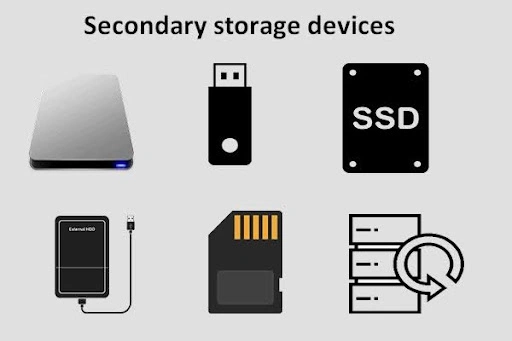
Example:-
- RAM (temporary storage)
- Hard Disk Drive (HDD)
- Solid State Drive (SSD)
- USB flash drive
Hardware is the backbone of any computer system or any workable system. It's undoubtedly a solid structure for any system to give a smooth experience. But to give a solid, user-friendly experience, software also plays a key role. Let's check the inner workings of the software and its types.
Different Types of Software - Total Insights
Software is fundamentally categorised into four types - System software, application software, utility software & combined software. Besides, there is some project management software that operates like both.
System Software
System software is developed specifically to control hardware and to provide an interface for running application software. In general, system software enables us to easily control computer hardware and provides a platform for other software to run. The most important type of system software is the OS. The operating system can vary for the device.
Operating systems such as Windows, macOS, and Linux are among the most common examples of system software. Device drivers, Firmware, programming language translators, etc., are also system software.
Functions of System Software:-
- Manages hardware resources (CPU, memory, storage)
- Controls input and output devices
- Provides security and access control
- Supports application software execution
Examples of System Software:-
- Operating Systems: Windows, Linux, macOS, Android, iOS
- Device Drivers: Printer drivers, graphics drivers, sound drivers
Application Software
Application software is developed to perform specific tasks. The main purpose of this software is to make the system convenient for the end-users. With the application software, a user can do their daily activities such as writing documents, browsing the internet, editing photos, or communicating online. There are many types of application software in the market. Application software mainly runs on top of system software. Its working process depends on the function.
Types of application software:-
- General-Purpose Application Software
- Special-Purpose Application Software
- Customised Application Software
- Educational Application Software
- Business Application Software
- Multimedia Application Software
- Communication Application Software
- Web-Based Application Software
- Mobile Application Software
Application software directly improves productivity, communication, and entertainment.
Examples of Application Software:-
- Microsoft Word – document creation
- Excel – data calculation and analysis
- Photoshop – image editing
- Web browsers – Chrome, Firefox
- Mobile apps – WhatsApp, Facebook, banking apps
Combine Software
Combine software refers to the software that can be used as either system software or application software. However, this concept is relatively new in software technology. Some software, such as Bhojon and Isshue, can function as both application and system software. You can get the PHP script and install it on your system. Thus, it will be working as application software. On the other hand, you can install the software into a specialized computer and use it as system software.
Utility Software
Utility software helps to maintain, protect, and optimize the performance of a computer system. These types of software ensure smooth operation and maintain system security. It basically works in the background and supports both system and application software.
Functions of Utility Software
- Protects against viruses and malware
- Cleans unnecessary files
- Backs up important data
- improves system speed and stability
Examples of Utility Software :
• Antivirus software
• Disk cleanup tools
• Backup software
How Do Hardware and Software Work?
Software like Bhojon includes a POS system feature. A POS system generally consists of a cash register, a printing unit, a monitor, a card-swiping machine, etc., that control the tasks we mentioned earlier. It keeps the whole transaction record of a physical store. And save the data on the central database.
Usually, Bhojon works like a web application. You can use them as application software on your computer hardware. But Bhojon has an extra advanced feature that makes it more versatile. You can install the desktop version of Bhojon, which helps you to track your business even offline.
On the other hand, when you integrate Bhojon with your POS system hardware, it will act as the system software for that hardware. That’s how some software can work as system software, and application software depends on the hardware on which it is installed.
How Do Software and Hardware Work Together?
By the time you understand the difference between hardware and software. Now you might be curious about how the whole thing works and how the software and hardware communicate. In this segment, you will get these answers.
The main component that plays the central role in connecting is the CPU. A CPU consists of an arithmetic and logic unit (ALU), a control unit, and registers. Usually, a processor completes an overall operation in three simple steps. The three steps are: fetching an instruction from memory, determining the operation type, and finally conveying an output.
Now you might ask how the CPU works. Well, first of all, the CPU consists of ICs that do all the tasks. See this video about how computers process information in less than a second.
End Note
So, that’s all about the difference between hardware and software. In a word, hardware and software are two primary components of a system. Without any of them, a system can not even exist. Their features and working methods are totally different from one another. Therefore, they have more dissimilarities than similarities. But still, they work as a team to give the best workflow for any operations.
FAQs
Can Hardware Work Without Software?
No. Hardware cannot perform any useful task without software instructions.
Can Software Exist Without Hardware?
No. Software needs hardware to run and execute its instructions.
What Are The Main Types Of Software?
The main types of software are:
• System software
• Application software
• Utility software
What Are Examples Of Application Software?
Examples include Microsoft Word, Excel, Photoshop, Google Chrome, WhatsApp, and mobile apps.
What Are Input Devices?
Input devices are hardware components used to enter data or commands into a computer, such as a keyboard, mouse, and scanner.
What Are Output Devices?
Output devices display or produce the processed results from a computer, such as a monitor, printer, and speaker.
What Is Firmware?
Firmware is a type of software embedded into hardware that controls low-level operations of a device, such as BIOS or router firmware.
Which Is More Important: Hardware VS Software?
Both are equally important. Hardware cannot function without software, and software cannot run without hardware.
Does Software Wear Out Like Hardware?
No. Software does not wear out physically, but it may become outdated or corrupted.
What Happens If Hardware Fails?
If hardware fails, software may not run properly or may stop working completely.
Can Software Be Upgraded Easily?
Yes. Software can usually be updated or upgraded without changing the hardware.
What is the Importance of Hardware
Can a system run without hardware? The answer is no. Software needs at least one hardware platform for implementation. However, you can’t do anything with a computer without a monitor and input devices like a keyboard and mouse. You also need other internal hardware such as a motherboard, CPU, and others, to run your computer. And you can’t even turn on your computer without proper hardware.
What is the importance of Software?
Can a system run without the software? The answer is that a system can run without application software, but it can’t run without the system software. So, lacking suitable software makes a system nothing but a piece of material.
What is Hardware and Software Integration Process?
The next part of the hardware and software differences concerns the interrogation process for these two. You might see how a restaurant conveys its job. Whenever you go to a restaurant, you might know that they take your order and keep the record on a computer-like system. Or sometimes scan a product's barcode with a device. Then again comes the billing part. In this case, if you give your credit or debit card, they swipe it on a card machine. All these machines are specialized for a business's POS system.




Pay With


